Octop
README 摘要
腾讯云开源自托管的智能 AI 助手,支持多用户、多智能体协作,让团队在私有环境中部署统一、自托管的 AI 助手服务。
项目 README
A smarter, self-hosted AI assistant — multi-user, multi-agent.








Highlights · Overview · Core Technology · Features · Roadmap · Quick Start · Contents
English · 中文
Octop is an open-source, self-hosted AI assistant. It's not just a tool — it's a digital life form that can operate in parallel. Through its multi-agent architecture, it builds an intelligent environment that is both independent and collaborative for teams, families, and individuals. Best of all, it runs entirely on your machine — the fully self-hosted design means privacy is never a compromise, while single-process startup makes the powerful web console, CLI, and IM integrations readily accessible.
Chat through the Web Dashboard, Feishu, DingTalk, QQ, WeChat, Telegram, Discord, WeCom, or programmatic HTTP/SSE/WebSocket. Extend capabilities with the expert library, Connectors (OAuth + MCP), and ACP integration for IDE workflows.
✨ Highlights
| Feature | Description | |
|---|---|---|
| 👥 | Multi-user expert team | One admin, shared household; built-in expert library and expert market — switch specialists per scenario |
| 🤝 | Expert sharing | Publish experts and shared skill/sub-agent pools so teammates reuse proven setups instead of rebuilding them |
| 🎭 | MBTI personas | 16 personality templates plus an interactive quiz — give each agent a distinct character |
| 🎯 | AgentTeams (Beta) | A coordinator schedules multiple experts on multi-step work; details |
| 🔒 | Security built-in | JWT multi-user isolation, tool approval, shell command guardrails, and PII redaction — data stays local |
| 🔌 | Connector ecosystem | Tencent suite (Docs, Meeting, News, …); OAuth and MCP gateway extend resource boundaries |
| 💾 | Pluggable workspace backends | Local disk, Docker sandbox, PostgreSQL, or COS/S3 for agent files — separate from the control-plane DB |
| 🧠 | Portable memory | Powered by Octop Memory; memory migrates with the workspace |
| 📚 | Knowledge base | RAG over your documents; share corpora within a deployment and ground answers in your private data |
| 🧩 | Plugins | Extend Octop with third-party plugins; bundled plugins are seeded and toggled on demand |
| ↔️ | ACP bidirectional | octop acp for IDE/terminal AI; delegate to OpenCode / Claude Code with permission gates |
| 💻 | Terminal AI+ | Interactive shell in the browser — AI-assisted command execution and troubleshooting |
| 🌐 | Browser AI+ | Headless Chromium sessions for web automation, screenshots, and remote browsing |
| 🖥️ | Remote desktop | Live screen and input from the dashboard on Linux, Windows, and macOS — remote office work and GUI apps; one-click isolated desktop on headless Linux |
| 🪟 | Desktop client | Native Windows / macOS / Linux apps (and FnOS packages) alongside the web dashboard |
| 🏠 | Self-hosted | Dashboard, CLI, IM channels, and cron in one octop run — all data under ~/.octop/ |
📌 Overview
Octop is a self-hosted AI assistant platform for households and small teams. It runs a single process that serves a web dashboard, a CLI, IM channels (Feishu, DingTalk, QQ, WeChat, Telegram, Discord, WeCom, and more), and cron automation — all sharing one control-plane database under ~/.octop/ (SQLite by default; PostgreSQL optional).
Octop's design goal: keep every conversation, workspace, and credential on your own machine, while giving each user a personal team of specialized agents they can switch between per task.
🐾 What can you do with Octop
- Personal assistant — let a dedicated agent write weekly reports, organize notes, and manage your schedule; memory persists with the workspace.
- Family sharing — one admin account, the whole household; assign different agents and experts per member; share experts and knowledge bases when useful.
- Team helper — AgentTeams or parallel agents, bridging Feishu / DingTalk / WeCom / WeChat to route tasks into group chats.
- Developer boost — delegate coding tasks to OpenCode / Claude Code via ACP, or troubleshoot from the terminal with AI assistance.
- Web automation — use Browser AI+ and remote desktop for forms, screenshots, and GUI apps.
- Scheduled tasks — configure cron in natural language so the agent pushes or runs jobs on time every day.
🧠 Core Technology
| Layer | Technology |
|---|---|
| Language | Python 3.12+ |
| Web framework | FastAPI + uvicorn |
| Agent runtime | Octop Harness |
| Gateway | Octop Gateway |
| Control plane DB | SQLite (WAL, default) or PostgreSQL (optional) |
| Frontend | React 18 + TypeScript + Vite + Ant Design |
| Scheduling | APScheduler |
| ACP | agent-client-protocol |
| Build / quality | hatchling · ruff · mypy · pytest |
Octop is built on the Octop Harness stack — a set of focused runtimes that Octop composes into one process:
- Octop Harness — Agent runtime: model routing, tools, skills, and conversation checkpointing.
- Octop Gateway — multi-platform IM channel bridge that normalizes incoming messages into a single processing pipeline.
- Octop Memory — hierarchical recall with full-text search, so an agent's memory travels with its workspace.
- Octop Browser — CDP-based browser automation with persistent profiles for web tasks.
Instead of an external queue or message broker, Octop routes every surface — Web UI, IM, and cron — through one in-process HarnessProcessor. The result is a single, restart-safe process whose entire state is rebuilt from the control-plane database on boot (local SQLite by default; PostgreSQL optional).
🤔 Features
Server & auth
- Multi-user JWT authentication with admin role
- First-run setup wizard (
octop init) - Interactive API docs at
/api/docs(off by default — set"enable_api_docs": trueinconfig.jsonto enable)
Experts
- Multiple experts per user; each has its own workspace, providers, channels, and cron
- 16 MBTI persona templates + custom system prompt
- Expert library scanned at boot (
infra/agents/experts/library/); expert market and in-deployment expert sharing - AgentTeams (Beta) — coordinator + member experts for multi-step tasks (docs/expert-teams.md)
- Workspace backends (expert files): local disk, Docker sandbox, PostgreSQL, COS/S3, and other remote stores — distinct from the control-plane database
Channels & automation
- IM channels: Feishu, DingTalk, QQ, WeChat, Telegram, Discord, WeCom, and more
- Proactive cron jobs with natural-language and slash-command triggers
- Unified message processing across Web UI, IM, and cron surfaces
Surfaces
- Web dashboard — chat, experts / teams, connectors, channels, cron, knowledge, plugins, settings
- Desktop client — native apps for Windows / macOS / Linux; FnOS packages for NAS
- CLI —
octop run,octop chats,octop acp, admin commands - HTTP/SSE/WebSocket API — full programmatic access
- Remote desktop — dashboard control of the host desktop session
Knowledge & plugins
- Knowledge base — RAG over your documents; optional sharing within the same deployment
- Plugins — install and manage third-party plugins (
octop plugin); bundled plugins are seeded and toggled on demand from the dashboard
ACP (Agent Client Protocol)
Octop supports ACP in two directions:
- Inbound — external tools use your Octop agent
octop acp --agent main # stdio ACP server for Zed, OpenCode, …- Outbound — Octop delegates to external coding agents
- Dashboard → ACP (
/acp): configure runners (global per user) - Enable acp_runner per agent, then delegate in chat
Built-in outbound runners include OpenCode, CodeBuddy, Claude Code, and Codex.
Full setup: docs/acp.md.
🧭 Roadmap
Here are our mid-to-long term plans:
Shipped
- Shared resource pool — a central pool of skills and sub-agents that any user can drop into a new expert without rebuilding from scratch.
- Expert sharing — publish your experts to other users in the same deployment, so good configurations are reused instead of recreated.
- PC client — native desktop apps for Windows / macOS / Linux alongside the web dashboard and IM channels.
In progress
- AgentTeams (Beta) — let one coordinator autonomously schedule and orchestrate multiple experts to tackle multi-step tasks.
- Mobile client (closed beta) — native mobile apps currently in internal testing.
Planned
- Browser & terminal polishing — browser skill recording (capture a workflow and replay it as a skill) and a more capable terminal AI assistant.
- Self-evolution — automatically distill everyday conversations into reusable skills, so the assistant grows with you.
- Managed Agents — platform-hosted agent lifecycle (provision, scale, and operate agents without managing the full self-hosted stack yourself).
- Project — project-scoped workspaces that group agents, files, and conversations around a shared goal.
- Cloud–edge continuum — run Octop locally while offloading selected tasks to the cloud, so light work stays on-device and heavier jobs use remote capacity when you need it.
- Plugin marketplace — a curated market to discover, install, and update third-party plugins without leaving Octop.
- Conversational control plane — deepen Octop’s own skills so chat can cover the full dashboard surface: create experts, wire channels, manage knowledge bases, and scaffold plugins end-to-end.
This roadmap may shift as the community grows; treat it as indicative only.
🚀 Quick Start
Prerequisites
- macOS / Linux / Windows
- No pre-installed Python required — the installer uses uv to provision Python 3.12 in an isolated venv under
~/.octop/ - A modern multi-core CPU with a few GB of RAM for the process plus model/embedding caches; enough disk for the database, agent workspaces, and document corpora
1. Install
macOS / Linux — one-line installer (recommended):
curl -fsSL https://finnie-1258344699.cos.ap-guangzhou.myqcloud.com/octop/install.sh | bashWindows (PowerShell):
irm https://finnie-1258344699.cos.ap-guangzhou.myqcloud.com/octop/install.ps1 | iexWindows (cmd) — download and run, or from a cloned repo:
curl -fsSL https://finnie-1258344699.cos.ap-guangzhou.myqcloud.com/octop/install.bat -o install.bat
install.bat
After installation, open a new terminal or reload your shell:
source ~/.zshrc   # Zsh
# or
source ~/.bashrc  # Bash
The installer places octop on your PATH via ~/.octop/bin. Optional extras:
# Download Playwright Chromium for browser automation (skipped if a system Chrome/Chromium is already present)
curl -fsSL https://finnie-1258344699.cos.ap-guangzhou.myqcloud.com/octop/install.sh | bash -s -- --extras browser
See scripts/README.md for all install options (--version, --from-source, --mirror, Windows flags).
Desktop app (GUI, no terminal) — grab the artifact for your platform from GitHub Releases:
| Platform | Artifact |
|---|---|
| Windows | Octop-desktop-windows-amd64- (64-bit) / Octop-desktop-windows-arm64- (ARM64) — NSIS installer |
| macOS | Octop-desktop-darwin-arm64- (Apple Silicon) / Octop-desktop-darwin-amd64- (Intel) |
| Linux | Octop-desktop-linux-amd64- / Octop-desktop-linux-arm64- |
| FnOS NAS | Octop-fnos-docker- (Docker-backed) / Octop-fnos-native- (no Docker) — install via App Center |
See desktop/README.md for the desktop shell and fnos/README.md for the FnOS packaging guide.
Alternative — PyPI (if you already manage Python yourself):
pip install octop
# optional local ONNX embedding model cache (Models → Local): pip install "octop[local-embedding]"
# Downloads catalog weights under ~/.octop/embedding_models; not chat, not Memory.
# Browser automation uses the bundled Playwright package; install Chromium via the installer --extras browser,
# the dashboard, or: python -m playwright install chromium
From a source checkout with uv:
uv sync --extra local-embedding2. Initialize
octop initThe interactive wizard creates the SQLite database, JWT secret, and first admin account under ~/.octop/.
3. Run
# Foreground (API + Web dashboard)
octop run

# Custom host / port
octop run --host 0.0.0.0 --port 8088

# Register as a system service (systemd / launchd / Windows service)
octop service start
Open http://127.0.0.1:8088. With Docker, the first init generates a random admin password (written to /data/.octop/credential.txt) unless OCTOP_DEFAULT_PASSWORD is set. Interactive octop init / the setup wizard asks you to choose a password (≥8 characters, letters and digits).
Docker (recommended for production)
# Build and start
docker compose -f docker/docker-compose.yml up -d

# Or build manually
bash docker/docker_build.sh
docker run -d \
  -p 8088:8088 \
  -v octop-data:/data/.octop \
  -e HOME=/data \
  -e OCTOP_DEFAULT_PASSWORD="<strong-password-or-omit-for-random>" \
  octop:latest
Open http://localhost:8088. First boot creates the admin account and writes the credentials to /data/.octop/credential.txt in the container. With OCTOP_DEFAULT_PASSWORD unset a strong random password is generated; a password you set must be ≥8 characters with letters and digits (weak/common passwords are rejected by the app password policy and fall back to a random one). Override the username via OCTOP_ADMIN_USERNAME.
Password policy: at least 8 characters with letters and digits.
| Variable | Default | Description |
|---|---|---|
OCTOP_PORT | 8088 | HTTP listen port |
OCTOP_DEFAULT_PASSWORD | _(unset)_ | First-run admin password (Docker bootstrap). Unset = random password written to credential.txt |
OCTOP_ADMIN_USERNAME | admin | First-run admin username |
OCTOP_DATA | ~/.octop | Host data directory (compose bind mount) |
See .env.example for the full list.
📑 Contents
- Highlights
- Overview
- Core Technology
- Features
- Roadmap
- Quick Start
- Deploy & Use
- Install options
- Configuration
- CLI reference
- Web dashboard
- Data directory
- Architecture & Dev
- Architecture
- Project layout
- Development
- Project Info
- Security & privacy
- Contributing
- Changelog
- Related projects
- Community
- License
📦 Install options
| Method | Platform | Description | |
|---|---|---|---|
| Remote one-liner | macOS / Linux | `curl …/octop/install.sh \ | bash` |
| Remote one-liner | Windows | `irm …/octop/install.ps1 \ | iex or install.bat` |
| Local script | macOS / Linux | bash scripts/install.sh | |
| Local script | Windows | scripts\install.bat or install.ps1 | |
| PyPI | Any | pip install octop (optional extras such as local-embedding) | |
| Docker | Any | docker/docker-compose.yml |
All install scripts provision an isolated environment at ~/.octop/venv and a ~/.octop/bin/octop wrapper — they do not touch system Python.
Upgrade
octop update replaces only the wheel/binary — your ~/.octop/ database, workspaces, secrets, and config.json are preserved:
octop update # fetch and install the latest octop, then restart the service if one is registeredThe schema migrates automatically on next boot; run octop init only if the setup wizard prompts for a migration. Always back up first (octop backup) before a cross-version upgrade.
⚙️ Configuration
All runtime state lives in ~/.octop/. Manage it via CLI or edit files directly.
# LLM providers and models
octop models
octop provider list

# IM channels
octop channel list
octop channel install

# Skills (per agent)
octop skills list --agent main

# Cron jobs
octop cron list
octop cron create --help

# Users (admin)
octop user list
Supported LLM providers
OpenAI-compatible APIs, DashScope (Qwen), Ollama, and other presets — configure per agent in the dashboard or via octop provider.
Supported channels
| Channel | Credentials |
|---|---|
| Feishu | App ID, App Secret |
| DingTalk | App Key, App Secret |
| Bot AppID, Token | |
| QR bind / account credentials; CLI | |
| Telegram | Bot Token |
| Discord | Bot Token; all accessible channels allowed by default, optional channel/DM allowlists; setup and testing |
| WeCom | Corp ID, Agent Secret |
| Web Dashboard | Enabled by default |
Other kinds (e.g. Yuanbao, Xiaoyi, MQTT) are available via the gateway — see channel setup in the dashboard or CLI.
📖 CLI reference
| Command | Description |
|---|---|
octop init | Bootstrap ~/.octop/ (DB, admin, JWT secret) |
octop run | Start Octop in the foreground |
octop service start | Install and start as a system service |
octop service stop | Stop the system service |
octop agent | Create, list, start/stop agents |
octop channel | Install and manage IM channels |
octop chats | REPL and session management |
octop acp | Stdio ACP server for IDE integration |
octop cron | Manage scheduled tasks |
octop models | Provider presets and model resolution |
octop skills | Enable/disable per-agent skills |
octop plugin | Install and manage third-party plugins |
octop backup | Export / restore backups |
octop clean | Remove CLI state or wipe ~/.octop/ |
octop memory list | List running agents eligible for memory maintenance; no database changes. |
octop memory slim [--agent ID] | Back up and slim SQLite memory through the running host; uses the selected agent or prompts by number. Shows terminal and dashboard progress. Details |
octop memory slim --all | Sequentially maintain all eligible running agents, with per-agent progress; stops on the first failure. |
octop update | Check for and install updates |
In signed-in dashboard or local CLI chat, /memory slim explains maintenance for the current agent; /memory slim --all lists your eligible agents. Add --confirm to start after reviewing the impact. Use /memory status for progress/results. Chat stays available until maintenance is confirmed and begins. External IM maintenance requires verified sender permissions and is not enabled yet.
Full reference: docs/cli.md.
🖥️ Web dashboard
After octop run, open http://127.0.0.1:8088.
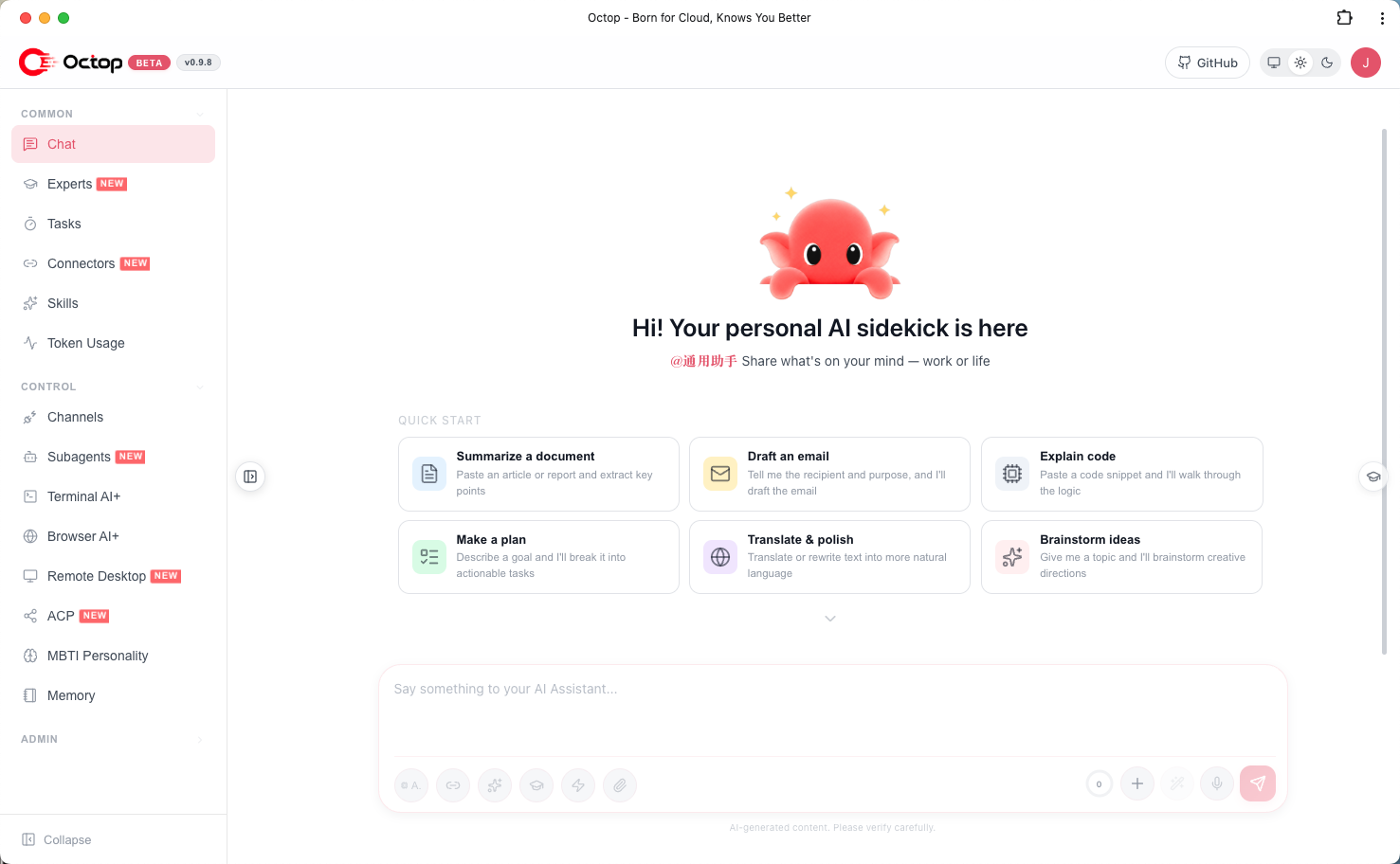
- Chat — real-time conversation with experts and teams
- Experts — create experts, pick templates / MBTI personas, share or publish experts, configure providers
- AgentTeams (Beta) — coordinator + member experts for multi-step work
- Connectors — OAuth apps and MCP gateways
- Channels — IM platform setup
- Cron — visual cron job management
- Knowledge base — manage document corpora, semantic retrieval, and in-deployment sharing
- Plugins — install, enable, and configure plugins
- Remote desktop — live screen and input from the dashboard
- ACP — configure outbound coding-agent runners
- Settings — users, security, TLS, system
Interactive API docs: http://127.0.0.1:8088/api/docs (disabled by default — enable by setting "enable_api_docs": true in config.json)
📁 Data directory
~/.octop/                          ← install & data root
├── config.json                    # process config (optional database section)
├── octop.db                       # SQLite — users, agents, channels, cron, …
├── secrets/                       # JWT secret, channel tokens
├── agents/<agent_id>/             # per-agent workspace (SOUL.md, skills, …)
├── security/tool_guard/           # shell command allow/deny rules
├── logs/                          # runtime logs
├── venv/                          # uv-managed Python (installer layout)
└── bin/octop                      # PATH wrapper → venv/bin/octop
The control plane can also use PostgreSQL — set database in config.json, or OCTOP_DATABASE_* / the first-run wizard. With PostgreSQL, agent memory reuses the same DSN by default (per-agent schema); to keep file-based memory, set "memory": { "backend": { "type": "sqlite" } } in the agent config. See docs/configuration.md and docs/adr/002-database-backends.md.
See docs/configuration.md for env vars and config.json.
🏗️ Architecture
OctopServer
 ├─ DatabasePool            SQLite (WAL) or PostgreSQL
 ├─ SharedServices       DI root — every repo + config
 ├─ ExpertCatalog        scans agents/experts/library/ at boot
 ├─ UserManager
 │   └─ HarnessAgentManager (per user)
 │       └─ AgentRuntime (per agent)
 │           ├─ HarnessAgent      Agent runtime (octop-harness)
 │           ├─ HarnessProcessor  IM / UI / cron entry point
 │           ├─ ChannelManager    IM connections (octop-gateway)
 │           └─ CronManager       APScheduler
 └─ FastAPI app (uvicorn)
Single process. Restart rebuilds state from the control-plane database (local SQLite by default; PostgreSQL optional).
See docs/architecture.md, docs/adr/001-single-process-model.md, and docs/adr/002-database-backends.md.
📁 Project layout
src/octop/
  config.py    env-var config
  launch.py    OctopServer boot + uvicorn
  infra/       business core (agents, gateway, cron, db, users, …)
  api/         HTTP layer — FastAPI app, routers, JWT, SSE
  cli/         CLI layer — Click commands
  dashboard/   built React SPA (wheel artifact)

dashboard/     frontend source (Vite) — edit here, run make build-frontend

docker/        Docker Compose, entrypoint, build & deploy scripts
tests/         unit/ + integration/
🛠️ Development
Prerequisites: Python 3.12+, Node 18+, uv
# Backend
make install          # pip install -e ".[dev]"
make all              # format-all + lint + typecheck + test (ship bar)

# Frontend (separate terminal)
make dev-frontend     # Vite dev server on :5173 (override with VITE_DEV_PORT)
make build-frontend   # production build → src/octop/dashboard/
cd dashboard && npx tsc -b
Individual targets: make test, make lint, make typecheck, make format.
🔒 Security & privacy
- Local-first: Config, chats, workspaces, and credentials live under
~/.octop/on your machine. - Multi-user isolation: JWT auth with per-user agents and workspaces.
- PII redaction & tool approval: sensitive data is redacted before it leaves the workspace, and risky tools or shell commands require explicit approval under the guardrail rules.
- Tool guardrails: User-editable shell command rules under
~/.octop/security/tool_guard/. - No vendor lock-in: Swap LLM providers, storage backends, and channels without rewriting agents.
🤝 Contributing
Contributions are welcome:
- Fork the repository
- Create a feature branch (
git checkout -b feature/amazing-feature) - Run
make all(backend) ormake check-all(full stack) before submitting - Open a Pull Request
See CONTRIBUTING.md for the full guide. Security issues: SECURITY.md.
Module boundaries and coding conventions: AGENTS.md.
📋 Changelog
See CHANGELOG.md for release history.
🔗 Related projects
| Project | Description |
|---|---|
| Octop Harness | Agent runtime — model routing, tools, skills, checkpointing |
| Octop Gateway | Multi-platform IM channel bridge |
| Octop Memory | Hierarchical recall and FTS search |
| Octop Browser | CDP browser automation with persistent profiles |
💬 Community
- Discord — join the English-speaking community: discord.gg/jPas5J8Ua
WeCom Customer Group (CN)
For the customer WeCom support group, scan:

Please scan the QR code to join the group. For any questions or assistance, please contact the group admin directly.
📄 License
This project is licensed under the MIT License.
✨ Contributors
Thanks to all contributors:
 电话咨询
电话咨询 微信咨询
微信咨询